
Web Search vs NewsAPI MCP: Surface Answers vs Deeper Insight
Web search and MCP often deliver similar answers—but not the same depth. This evaluation shows how NewsAPI MCP uncovers more signals, broader coverage, and structured evidence, enabling LLMs to move beyond summaries toward real understanding.

Large language models are rapidly becoming research assistants. With built-in web search tools, AI systems can now retrieve current information, summarize developments, and answer complex questions.
This raises a natural question:
If an LLM can already use web search, why would it need a specialized News API?
At first glance, the two seem redundant. Search engines already surface articles, summaries, and commentary. But when AI systems start performing deeper research tasks — market intelligence, policy monitoring, trend analysis — the difference becomes clearer.
To explore this question, we ran a structured evaluation comparing web search with NewsAPI.ai via MCP (Model Context Protocol).
The results were surprising.
The NewsAPI.ai MCP Server is available on GitHub and npm. Register for a free API key at newsapi.ai.
The Experiment
We tested two approaches:
- an LLM using web search
- an LLM using NewsAPI.ai through MCP
The systems were given four real-world prompts:
- What are the latest developments in EU AI regulation?
- What is the current sentiment around NVIDIA in the news?
- Summarize the biggest tech events of the past week.
- What problems currently affect the auto industry in Europe?
Each response was evaluated using a structured scoring framework measuring:
- source quality
- recency
- coverage
- relevance
- structured evidence
- answerability
Each category was scored from 1 to 5, with a maximum score of 30 points.
The First Surprise: The Scores Are Nearly Identical
When we averaged the results across all prompts, the two systems performed almost equally well.
The difference is minimal.
This matters because it challenges a common assumption: that specialized APIs automatically outperform general search engines. In reality, both approaches produce high-quality answers.
Here is the comparison visually.
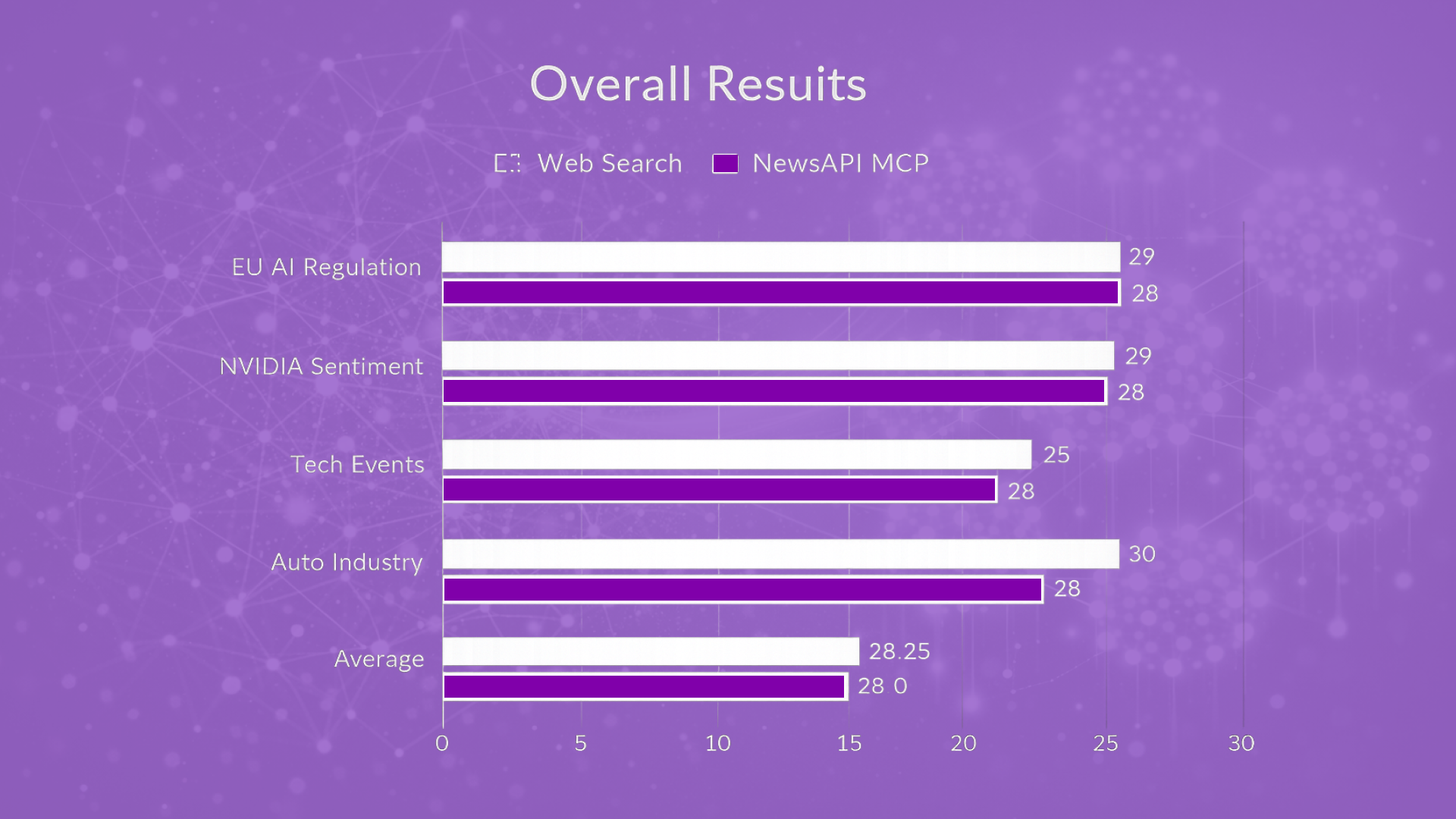
The takeaway is simple:
Web search is already extremely strong at answering questions.
But the real difference between the two systems appears somewhere else.
The Real Difference: Coverage
Although the final scores were very similar, the information discovered during the evaluation was not.
Across the four prompts:
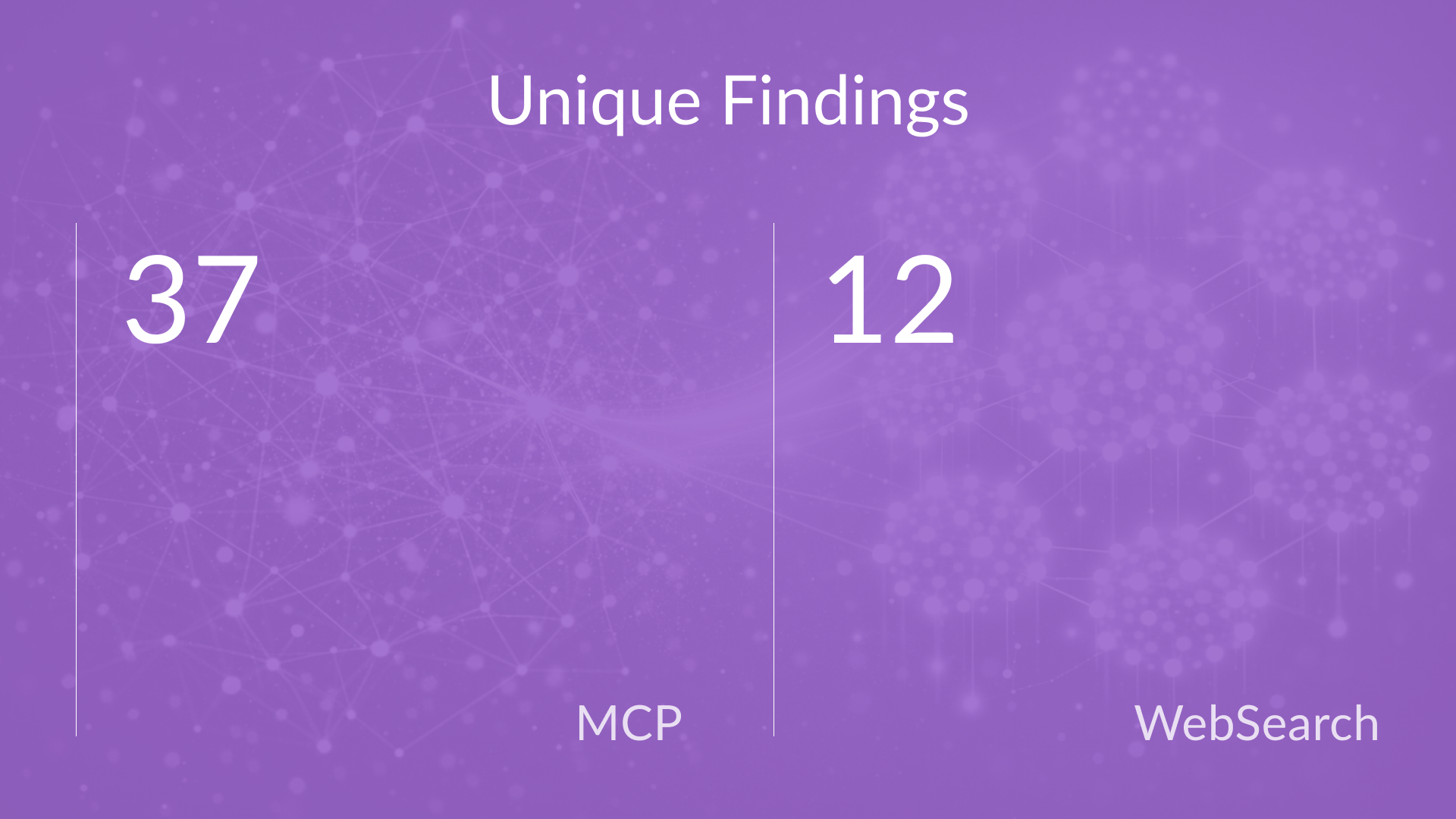
- NewsAPI MCP surfaced 37 unique findings
- Web search surfaced 12 unique findings
That is roughly a three-times advantage in unique information discovery.
Why does this happen?
Search engines are designed to surface:
- authoritative summaries
- widely referenced sources
- consolidated explanations
News APIs expose a different layer of information:
- primary reporting
- specialized industry analysis
- regional coverage
- early signals emerging in the news cycle
In short:
Search explains the story.News APIs reveal the full information landscape behind it.
Example: EU AI Regulation
When asked about the latest developments in EU AI regulation, web search produced a clear overview of the core regulatory framework and timelines.
But the NewsAPI MCP search surfaced several additional developments, including:
- a European Parliament resolution on generative AI copyright
- a joint regulatory opinion criticizing the Digital Omnibus proposal
- a new scientific paper on proportionality in AI regulation
- national implementation developments such as Denmark’s deepfake legislation
These pieces represent emerging developments that had not yet appeared in mainstream synthesized summaries.
In practice, this means an AI system relying solely on web search may understand the headline story, but miss parts of the broader policy landscape.
Example: Market Sentiment Around NVIDIA
A similar pattern appeared in the prompt analyzing NVIDIA’s media sentiment.
Web search summarized the major narrative:
- analyst ratings
- stock momentum
- conference expectations
NewsAPI MCP revealed additional signals, including:
- new ecosystem partnerships
- supply chain developments
- strategic investments
- article-level sentiment signals across coverage
Because MCP returns structured article data, it can also analyze per-article sentiment scores rather than relying purely on aggregated commentary.
For tasks such as:
- market intelligence
- brand monitoring
- competitive analysis
this level of granularity becomes extremely useful.
What This Means for LLM Research
One of the most interesting findings of the evaluation is that the two tools are not competitors.
They serve different purposes.
Web search excels at:
- quick orientation
- answering direct questions
- producing clear summaries
NewsAPI MCP excels at:
- deeper coverage discovery
- identifying emerging developments
- retrieving structured article data
- analyzing sentiment and event signals
In other words:
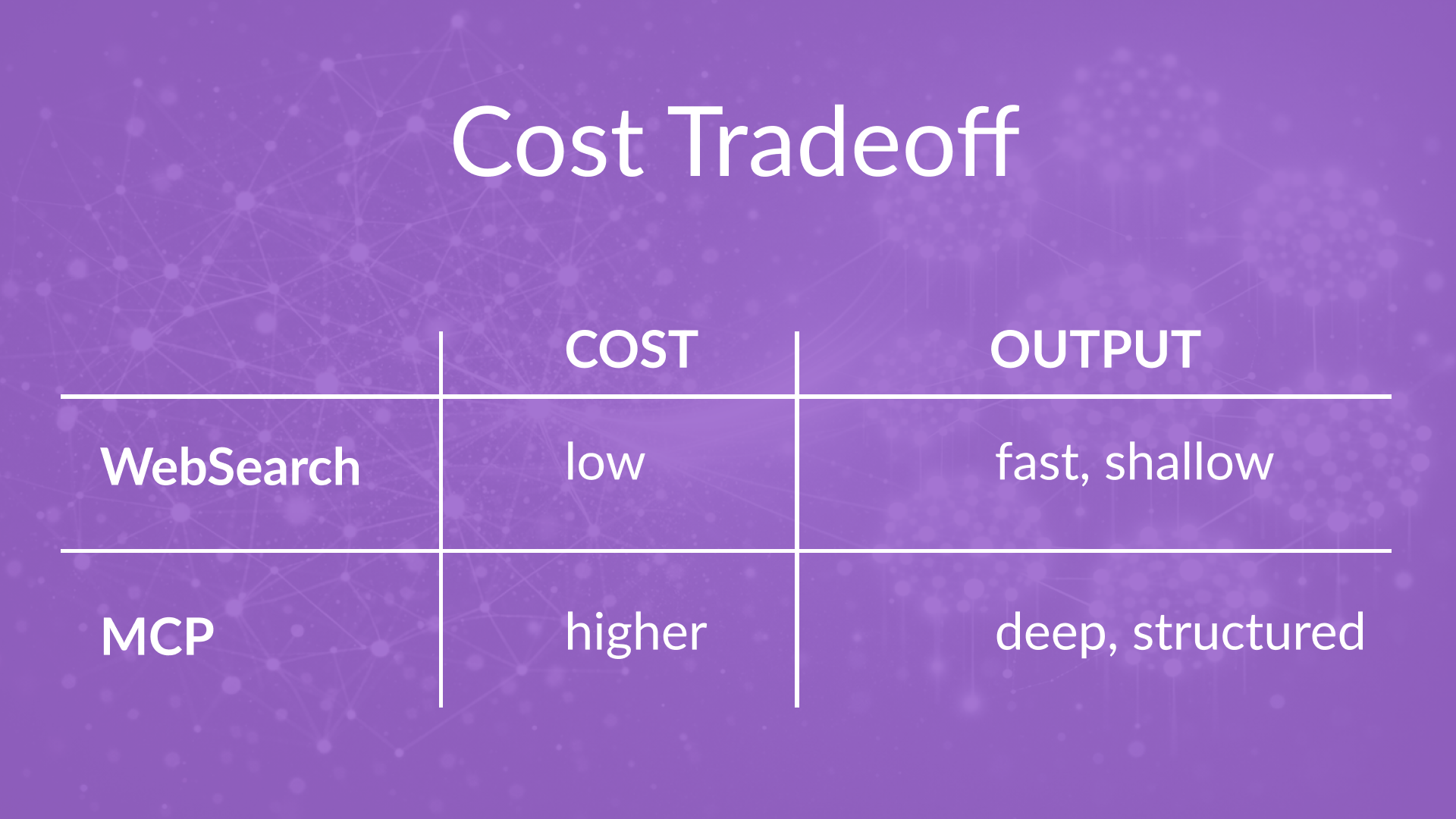
Search is optimized for answers.News APIs are optimized for evidence.
A Practical Workflow for LLM News Research
The most effective approach combines both tools.
A typical research workflow might look like this:
- OrientationUse web search to quickly understand the topic.
- DiscoveryUse NewsAPI MCP to scan broader news coverage.
- TriageIdentify the most relevant articles and events.
- Deep retrievalRetrieve structured article data and evidence.
This layered process allows LLMs to move from summary-level understanding to evidence-based analysis.
Why MCP Is Better Than Scraping or RSS
Developers who need news data traditionally rely on two imperfect approaches: scraping websites or consuming RSS feeds.
Both methods come with significant limitations.
Web scraping is fragile.News sites frequently change layouts, introduce paywalls, or block automated crawlers. Even when scraping works, it produces unstructured HTML that requires heavy post-processing before it becomes useful for analysis.
RSS feeds are more stable, but they expose only a small slice of information. Most feeds include limited metadata and typically provide just headlines or short descriptions rather than structured article data.
For AI systems, these approaches create a bottleneck.
Large language models work best when they receive clean, structured data rather than raw web pages.
This is where MCP changes the equation.
Instead of scraping articles, AI systems can access:
- structured article metadata
- concept identifiers for entities and topics
- sentiment signals
- event clusters
- source filtering and analytics
The difference is subtle but important. Scraping gives AI systems pages. MCP gives them information objects.
That makes the data far easier for LLMs to analyze, compare, and reason about.
When LLMs Move From Answers to Intelligence
The experiment revealed something interesting.
Web search is extremely effective at answering questions.
But answering a question and understanding a topic are not the same thing.
Search engines tend to surface the most authoritative summaries of a story. That works well when an AI system needs a quick explanation.
But when the goal shifts toward analysis, monitoring, or research, a different capability becomes important: coverage.
News APIs expose the broader landscape of reporting — including specialist analysis, regional perspectives, and early signals that may not yet appear in aggregated summaries.
That is why the evaluation uncovered three times more unique findings when using NewsAPI MCP.
For AI systems that need to work with news — whether for market intelligence, policy monitoring, brand analysis, or research — that deeper coverage can make a meaningful difference.
And this is where MCP becomes powerful.
It allows large language models to move beyond simple question answering and begin working with structured, evidence-based news intelligence.
The NewsAPI.ai MCP Server is available on GitHub and npm. Register for a free API key at newsapi.ai.