
How to Use NewsAPI MCP for LLM News Research (Step-by-Step Workflow)
Learn how to use NewsAPI MCP for LLM-based news research. This step-by-step guide explains the scan → triage → retrieve workflow, helping you move beyond summaries to structured analysis, better filtering, and deeper insights.

Large language models are rapidly becoming research assistants. With built-in web search tools, AI systems can now retrieve current information, summarize developments, and answer complex questions.
This raises a natural question:
If an LLM can already use web search, why would it need a specialized News API?
Developers are increasingly using large language models (LLMs) for news research, market intelligence, and real-time analysis. But while most AI systems rely on web search, structured news APIs offer a different approach — one that enables deeper coverage, better filtering, and more reliable insights.
If you haven’t read it yet, we first introduced the NewsAPI MCP Server and the idea of structured news for LLMs in our previous post.
Key Takeaways
- Web search is effective for quick answers, but limited in coverage
- NewsAPI MCP enables structured, multi-step LLM news research workflows
- The scan → triage → retrieve model improves both depth and precision
- LLM systems perform better when working with structured news data instead of scraped pages
Why LLM News Research Requires More Than One Query
Traditional LLM workflows often look like this:
Query → retrieve → answer
That works well for web search.
But structured news requires a different pattern — one that reflects how information actually appears in the world: fragmented, distributed, and evolving.
From our evaluation, the most effective approach is:
Scan → Triage → Retrieve
This is the key idea behind working with NewsAPI MCP.
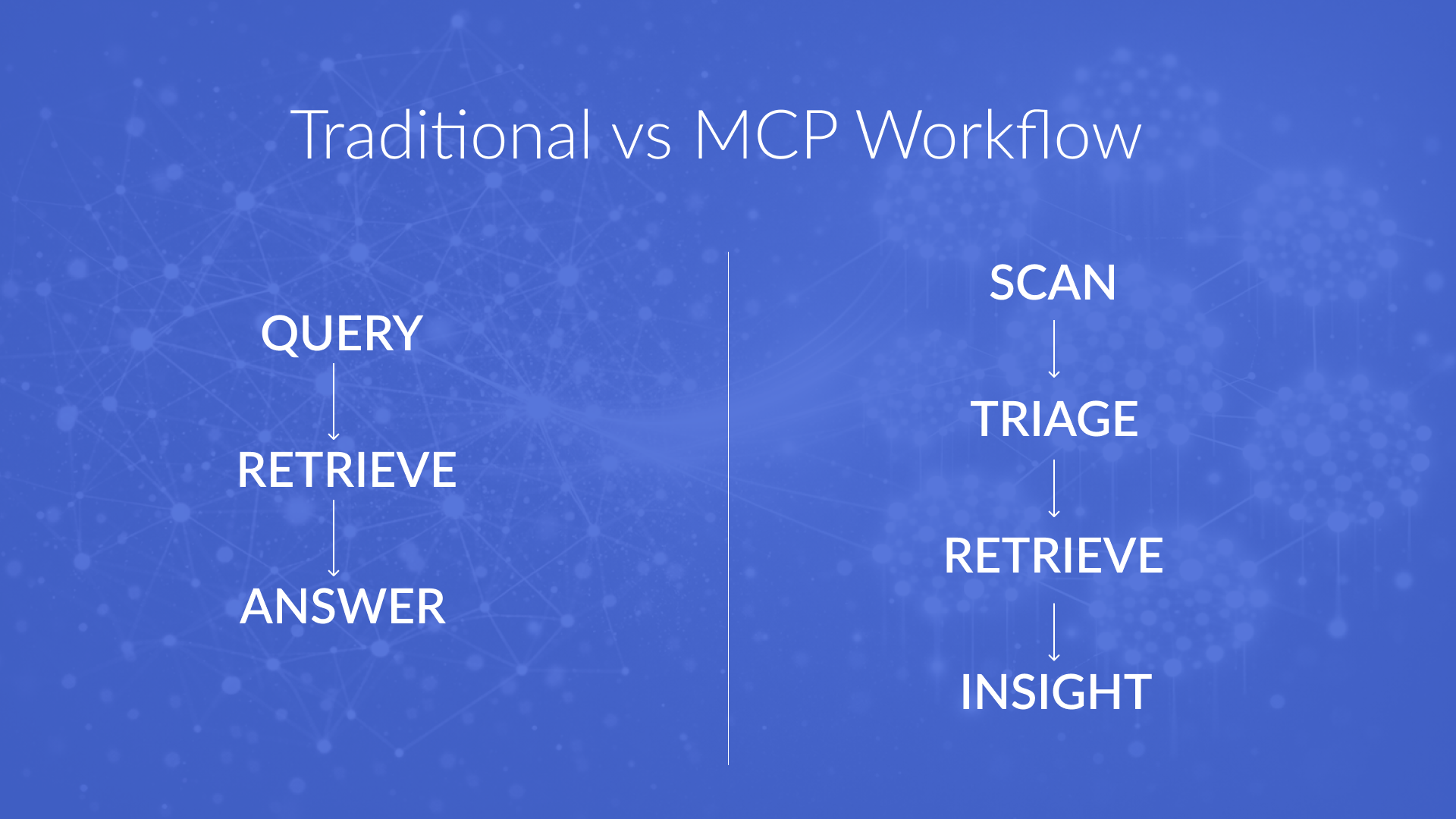
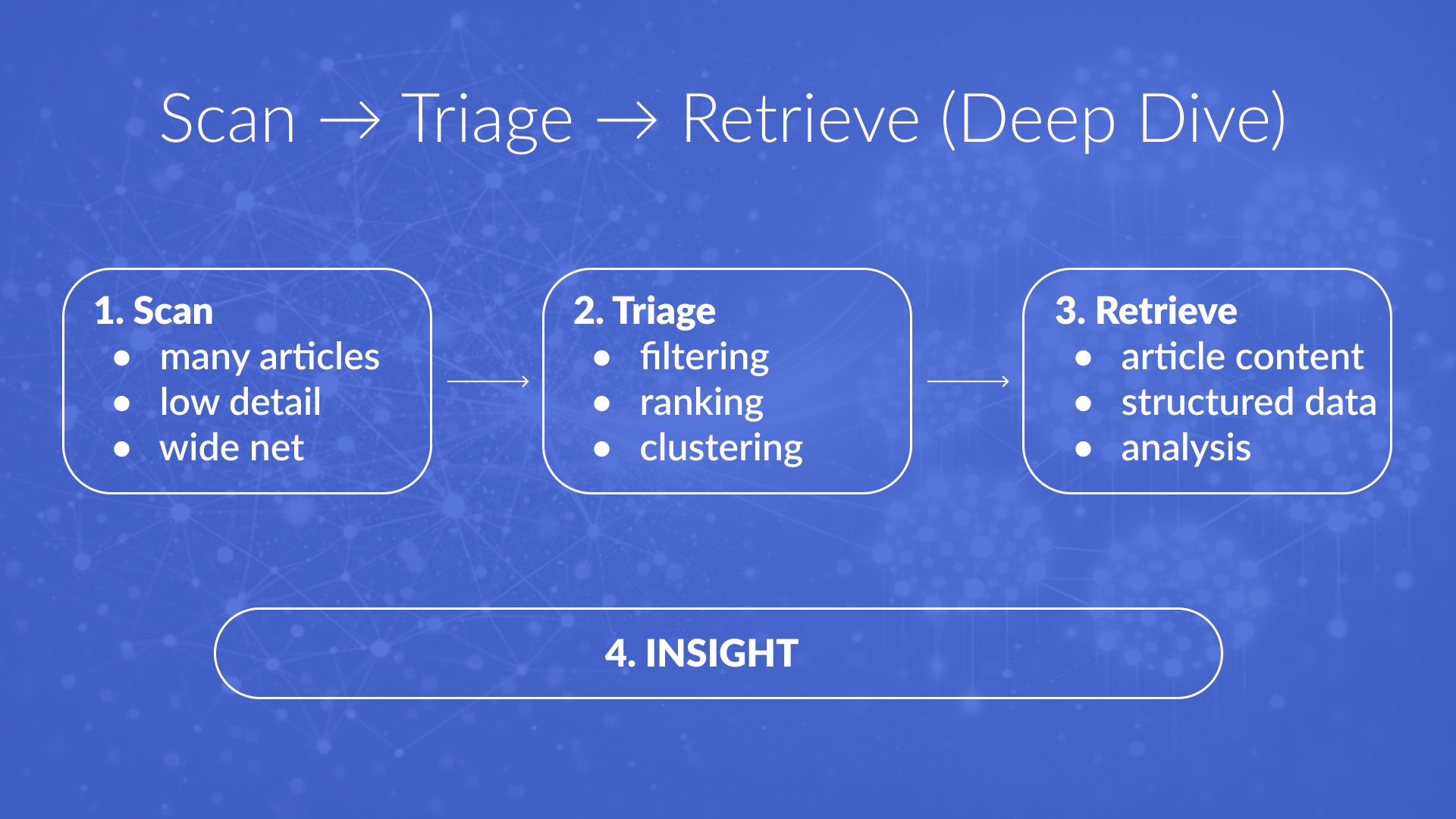
The NewsAPI MCP Workflow: Scan → Triage → Retrieve
Step 1: Scan (Broad Discovery)
The goal of the scan phase is simple:
Map the information space.
Instead of trying to get the perfect answer immediately, you run multiple broad queries to understand what exists.
Typical scan setup:
{
"action": "search_articles",
"conceptUri": "http://en.wikipedia.org/wiki/Nvidia",
"dateStart": "2026-03-04",
"dateEnd": "2026-03-11",
"articleBodyLen": 0,
"includeFields": "sentiment",
"isDuplicateFilter": "skipDuplicates"
}
Key ideas:
- Use article titles for initial triage (articleBodyLen=0)
- Run multiple variations of queries
- Focus on breadth, not precision
- Keep LLM context usage low during the scan phase
At this stage, you are not analyzing.
You are exploring.
Step 2: Triage (Selection)
The LLM identifies what matters based on the prompt and defined criteria.Rather than manually selecting results, the LLM evaluates the retrieved items and prioritizes them according to:
- recency
- source quality
- topic relevance
- signal strength (e.g. repeated mentions across sources)
In practice, this might result in:
- selecting the most relevant articles from a larger pool
- identifying key event clusters
- prioritizing the most widely covered developments
This step is critical.
It allows the system to reduce noise and focus on the information that best matches the user’s intent. Without triage, you either miss important signals — or drown in noise.
Step 3: Retrieve (Deep Analysis)
Now you switch from discovery to analysis.
You retrieve detailed data only for the selected items:
{
"action": "get_article_details",
"articleUris": ["uri1", "uri2", "uri3"],
"articleBodyLen": -1,
"includeFields": "sentiment,concepts"
}
Or for events:
{
"action": "get_event_details",
"eventUri": "event123"
}
The eventUri parameter can also accept multiple values, but in practice events are typically retrieved one by one during analysis.
At this stage, you can work with:
- structured article content
- sentiment signals
- concept metadata
- event-level aggregation
This is where actual insight emerges.
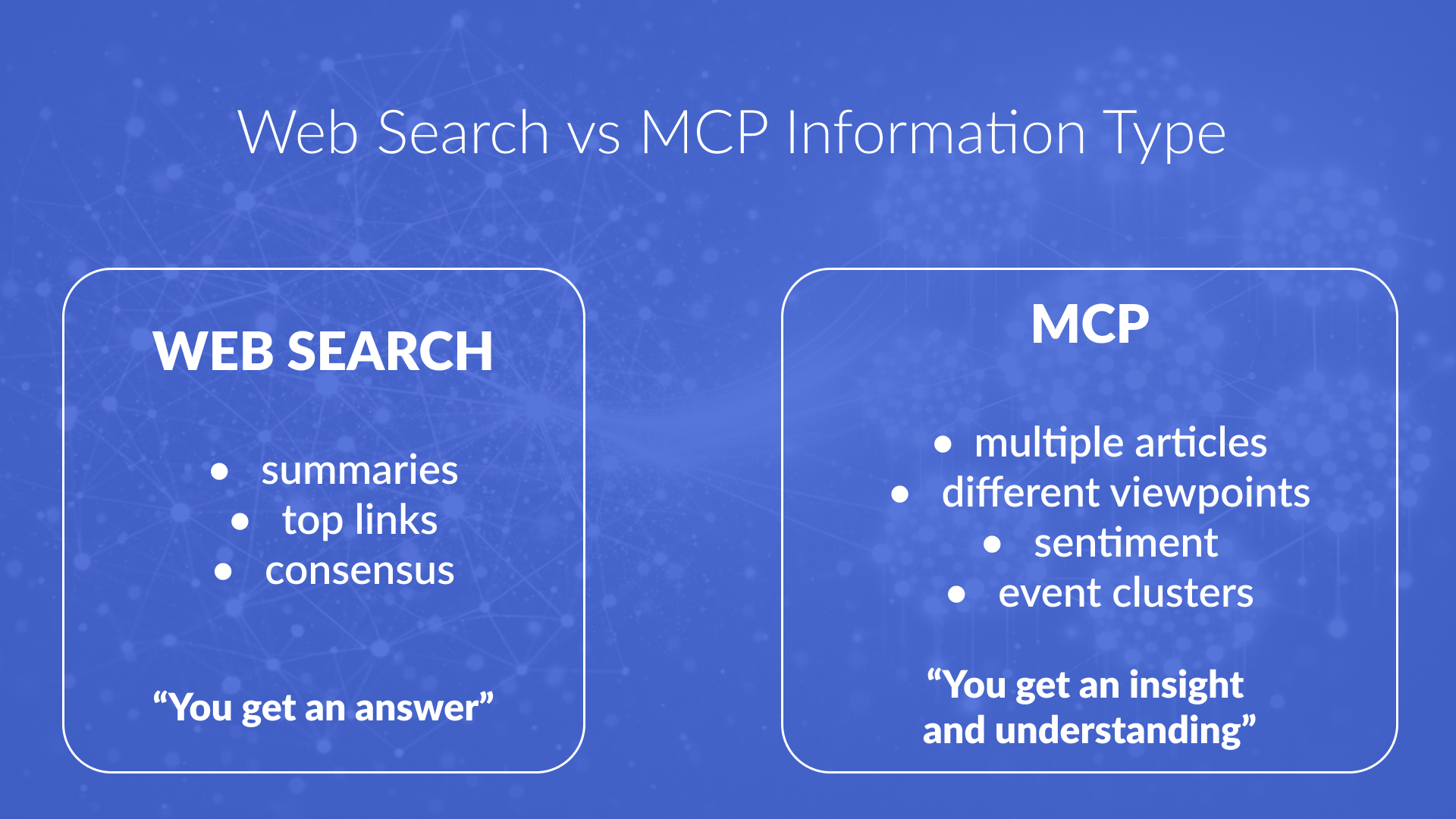
NewsAPI MCP vs Web Search: Key Differences in LLM Workflows
In practice, both web search and NewsAPI MCP can be used in iterative workflows.
Depending on the LLM’s reasoning capabilities, the system may call either tool multiple times — refining queries, exploring results, and retrieving additional information based on the prompt and intermediate findings.
The difference is not in whether iteration happens.
It’s in what kind of information is retrieved.
Web search tends to surface:
- consolidated summaries
- widely referenced sources
- high-level explanations
NewsAPI MCP provides access to:
- a broader set of articles
- multiple perspectives across sources
- structured signals such as sentiment and event clustering
As a result, NewsAPI MCP enables a deeper understanding of a topic by exposing:
- different viewpoints
- emerging developments
- gaps in coverage
- supporting evidence across multiple sources
It’s not a shift from one query to many.
It’s a shift from summarized answers to structured, multi-source understanding.
Example: LLM News Research Workflow for EU AI Regulation
Let’s make this concrete.
If you want to track developments in EU AI regulation:
Scan
Run multiple queries:
- AI Act + enforcement
- AI Act + Digital Omnibus
- national implementation
- specialist legal sources
This gives you a broad set of articles.
Triage
From the scan results, you might identify:
- new regulatory proposals
- parliamentary actions
- national-level implementations
- expert analysis
LLM selects the most relevant pieces.
Retrieve
Then retrieve structured data for those selected items.
At this point, you can:
- compare developments across countries
- identify new policy directions
- track how narratives evolve over time
Instead of a summary, you now have a structured view of the regulatory landscape.
Key Techniques for Better LLM News Analysis
From the evaluation, several patterns consistently improved results:
Use Multiple Queries
One query is rarely enough.
Combine:
- concepts (e.g. company, regulation)
- keywords (e.g. enforcement, risk, policy)
Work with Concepts, Not Just Keywords
Concept URIs help disambiguate meaning and improve precision.
Filter Early
Use:
- isDuplicateFilter
- date ranges
- source filters
to reduce noise during scanning.
Use Event Clustering
Event-based retrieval helps identify:
- the biggest stories
- the most widely covered developments
Control Token Usage
The scan → triage → retrieve model is efficient:
- scan = low-cost previews
- retrieve = targeted deep analysis
This allows more complex LLM workflows without excessive token usage.
When to Use NewsAPI MCP for LLM-Based News Analysis
This approach is especially useful when your system needs:
- market intelligence
- policy monitoring
- competitor tracking
- risk detection
- research dataset creation
- media monitoring
Any scenario where coverage and structured data matter more than a single answer.
How to Get Started with NewsAPI MCP (GitHub, npm & Docs)
If you want to try this workflow yourself, getting started is straightforward.
You’ll need:
- a NewsAPI.ai API key (get your free API key)
- Node.js 18+
- an MCP-compatible client
From there:
- connect it to your MCP client (using the npm package)
- start querying structured news
Full documentation, setup instructions, and examples are available on:
In our previous evaluation, we compared NewsAPI MCP with web search in detail — showing how each approach performs across real-world prompts.
Turning News Data into LLM-Ready Intelligence
The shift from web search to structured news is subtle, but important.
Web search helps LLMs answer questions.
NewsAPI MCP helps them work with information.
By combining:
- broad discovery
- structured filtering
- targeted retrieval
LLM-based systems can move beyond summaries and start producing evidence-based insights.
And that is where news becomes more than content.
It becomes data you can reason with.
Frequently Asked Questions
What is MCP in AI?
MCP (Model Context Protocol) is a standard that allows large language models (LLMs) to connect to external tools and data sources. It enables AI systems to retrieve structured, real-time information instead of relying only on static knowledge or web search.
How do LLMs get real-time news data?
LLMs retrieve real-time news data by connecting to external sources such as news APIs. With protocols like MCP, they can access structured news data directly, including articles, metadata, and signals like sentiment or event clustering.
Why use a news API instead of web search for AI?
Web search is designed to provide summarized answers, while news APIs provide structured and filterable data. This allows AI systems to analyze multiple sources, detect patterns, and work with more complete information.
What is the best way to analyze news with LLMs?
The most effective approach is a multi-step workflow:
- Scan a broad set of articles
- Triage the most relevant results
- Retrieve detailed structured data
This allows LLMs to move beyond summaries and produce deeper insights.
Can ChatGPT or Claude use news APIs?
Yes. LLMs like ChatGPT or Claude can use news APIs when connected through tools such as MCP. This allows them to access real-time and structured news data instead of relying only on web search.
What is the difference between web search and news APIs for AI?
Web search provides ranked results and summaries, while news APIs provide structured data from multiple sources. News APIs enable deeper analysis, while web search is better for quick answers.
How do you use a news API with LLMs?
A common workflow includes:
- scanning multiple queries
- selecting relevant results
- retrieving structured data for analysis
This approach improves both coverage and accuracy.
What is structured news data?
Structured news data includes organized information about articles, such as entities, topics, sentiment, and event relationships. This makes it easier for AI systems to analyze and compare information across sources.
Is web search enough for AI news analysis?
Web search is useful for quick understanding, but it often misses deeper or emerging developments. For more comprehensive analysis, structured news data provides better coverage and insights.
How can I start using NewsAPI with AI?
You can start by getting an API key, connecting through an MCP-compatible client, and using structured queries to retrieve and analyze news data within your AI workflows.